

|
In his work
entitled, The Catholic Church in Connecticut, Thomas Duggan states
that, "The Catholic Church has been represented in Connecticut
from the days of its earliest white settlers." From colonial
times until the arrival of the first resident in 1651, the Catholic
Church in Connecticut lived very much in the shadows of the deeply
Congregational tradition. The missionary zeal of those early priests
led to the establishment in Hartford of the Church of the Holy Trinity
which was dedicated by Bishop Fenwick on May 8, 1834. Nine years
later in the spring of 1843, Bishop Fenwick, who was advanced in
age, recommended to the Fifth Provincial Council of Baltimore that
greater concern be given to the care of the Catholic souls in Connecticut.
Bishop Fenwick proposed that his Boston diocese be divided so that
a separate diocese could be established encompassing the States
of Connecticut and Rhode Island.
On November
28, 1843, Pope Gregory XVI issued a Papal Bull establishing the
See of Hartford with Reverend William Tyler, Vicar General of Boston
and a convert to Catholicism, as its founding bishop. The primary
responsibility of the young bishop would be the pastoral care of
the 10,000 Catholics who comprised the diocese. Believing that the
bishop should be nearer to the greater number of Catholics, in 1844,
Bishop Tyler petitioned Rome to move the See of Hartford to Providence,
Rhode Island. A man of great humility, Bishop Tyler struggled to
reduce the large debt, and with missionary zeal, spent his life
in service of his new flock. Bishop Tyler died in 1849, at the early
age of 45 after serving as a bishop for five years.
Hartford's
second bishop, the Right Reverend Bernard O'Reilly worked untiringly
to secure young priests for the diocese. While remaining in Providence,
he sought to shield his flock from the anti-Catholic movements of
the era, such as the Know-Nothing Party that was striving to destroy
the Catholic Church in America. Bishop O'Reilly was lost at sea
on the ill-fated steamer, Pacific, in January 1856.
Pennsylvania
born, Reverend Francis McFarland was consecrated the third bishop
of Hartford in Providence on March 14, 1858. Bishop McFarland oversaw
a Church which was growing rapidly and which eventually led to the
establishment of the Diocese of Providence in 1872. Although in
ill health, Bishop McFarland attended the first Vatican Council
in Rome (1869-1870). This "Civil War bishop" has left
to our archives a lasting memorial of his extensive writings in
diary form.
Two years
after Bishop McFarland's death, an Augustinian friar, Father Thomas
Galberry, O.S.A., was named the fourth bishop of Hartford. Shortly
after his consecration, Bishop Galberry began the construction of
the original cathedral, laying the cornerstone on Sunday, April
29, 1877. The brownstone edifice was located on the north side of
Farmington Avenue next to a then recently erected Motherhouse of
the Sisters of Mercy. Bishop Galberry, who never enjoyed good health,
died suddenly which en route to Villanova College in Philadelphia.
His death deprived the diocese once again of a devoted and most
capable shepherd.
Father Lawrence
McMahon, a native of New Brunswick and a distinguished Civil War
chaplain, was named Hartford's fifth bishop in 1879. During his
episcopate of fourteen years, forty-eight parishes and sixteen parish
schools were established. In 1882, a young diocesan priest, Father
Michael McGivney, a native of Waterbury, organized in the basement
of St. Mary Church in New Haven, a small group of Catholic men who
would be known as the Knights of Columbus.
Father Michael
Tierney, Chancellor and Rector of the the newly dedicated cathedral,
succeeded Bishop McMahon as the sixth bishop of Hartford on February
22, 1894. Under Bishop Tierney's leadership, a preparatory seminary
of St. Thomas was founded on Collins Street in Hartford and dedicated
on September 8, 1889. Another major accomplishment of Bishop
Tierney
was the establishment of five diocesan hospitals which continue
to serve thousands throughout the State of Connecticut.
It could
be said that by the time Father John J. Nilan was installed as Hartford's
seventh bishop on April 28, 1910, Catholicism in Connecticut had
come of age. During his tenure, Bishop Nilan concerned himself with
the fostering of many ethnic parishes which would serve Connecticut's
diverse population. In April of 1920, Father John Murray was consecrated
first auxiliary bishop in Hartford. He was later name Ordinary of
Portland, Maine and subsequently the Archbishop of St. Paul.
The Most
Reverend Henry J. O'Brien, Bishop McAuliffe's auxiliary bishop who
earlier served as rector of St. Thomas Seminary, was named ninth
bishop of Hartford on April 7, 1945. During the prosperity of this
post war era, the number of Connecticut Catholics was growing and
many parishes were built in the suburbs. On August 6, 1953, Pope
Pius XII established the dioceses of Bridgeport and Norwich and
Hartford became an archdiocese, comprising Hartford, New Haven and
Litchfield counties. As a result, on October 21, 1953, Bishop O'Brien
was installed as the first Archbishop of Hartford. This time of
great joy was followed three years later by a time of sadness when
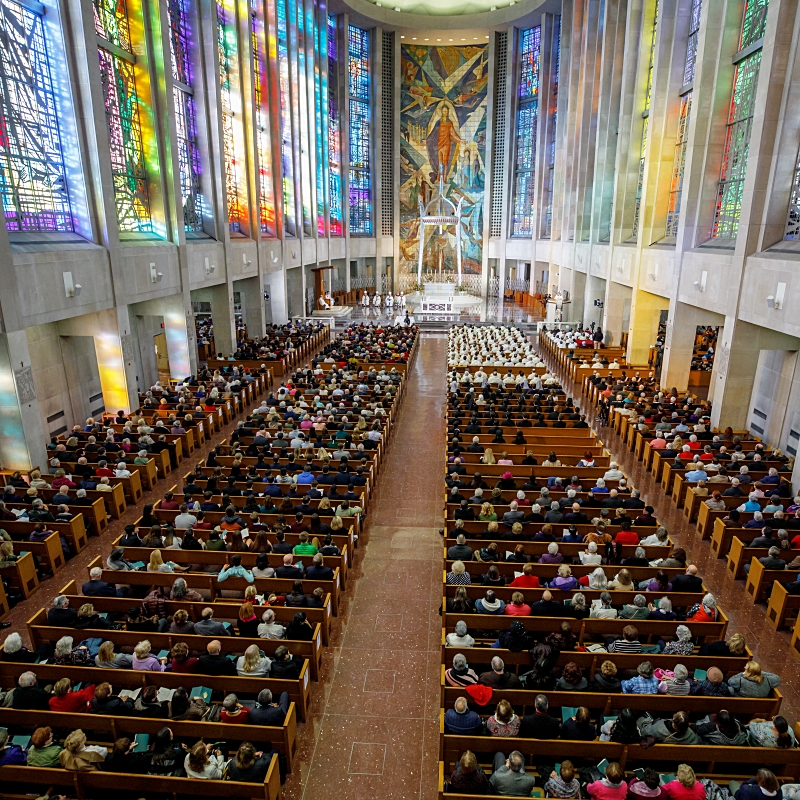
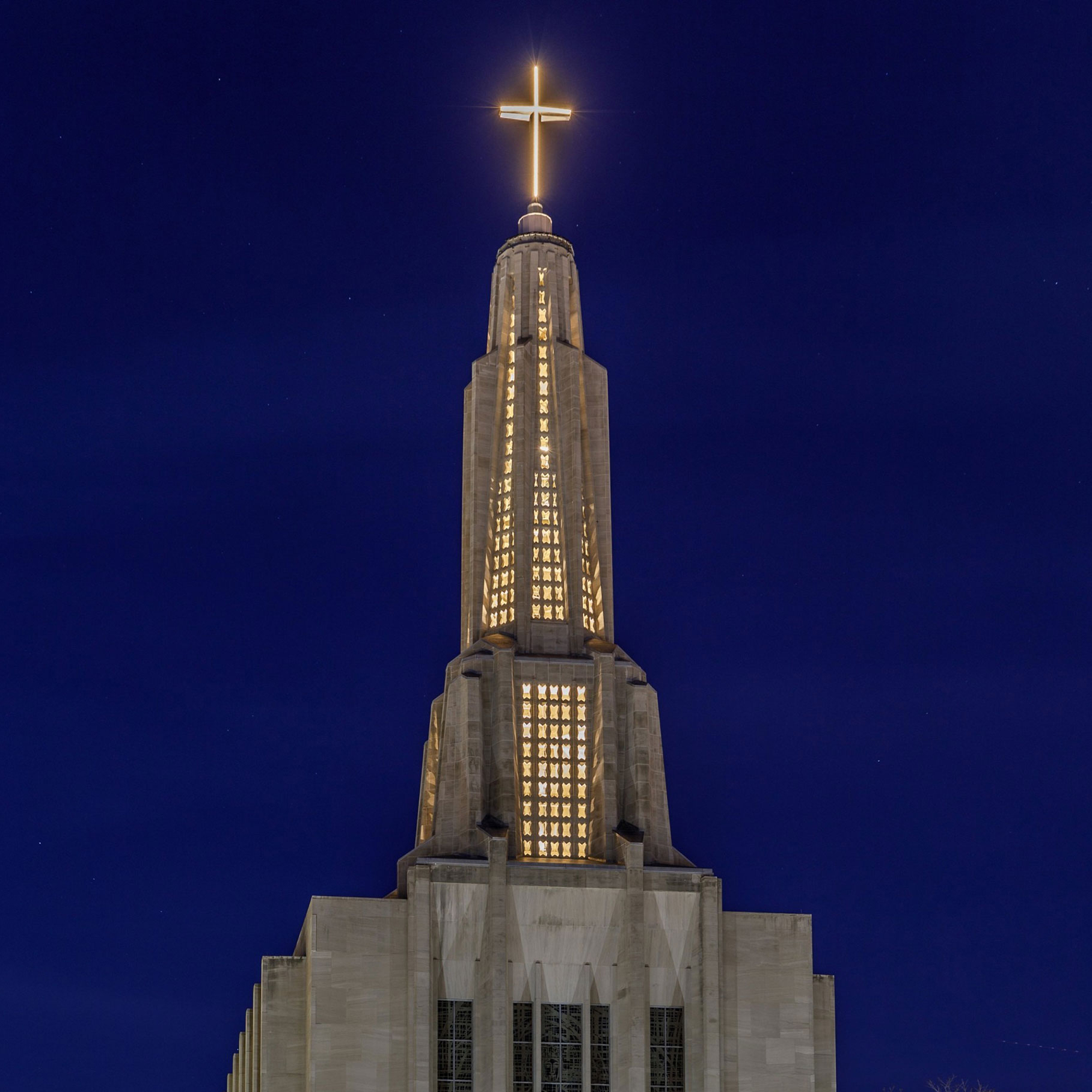
the Cathedral of St. Joseph was destroyed by fire on New Year's
Eve, 1956. Archbishop O'Brien immediately initiated plans for a
new cathedral to be built on the same site. On May 15, 1962, Auxiliary
Bishop John F. Hackett, consecrated the magnificent structure which
continues to serve as the Cathedral Church of the Archdiocese of
Hartford.
The Most
Reverend John F. Whealon, Bishop of Erie, Pennsylvania and a native
of Ohio, was installed as the second Archbishop of Hartford on March
19, 1969. Archbishop Whealon, a noted scripture scholar and ecumenist
served this Archdiocese for twenty-two years. During his administration,
the Church was blessed with a strong leader and able teacher who
devoted time each week in teaching seminarians at Holy Apostles
Seminary in Cromwell, as well as the permanent deacons of the Archdiocese.
On January
28, 1992, the Most Reverend Daniel A. Cronin, Bishop of Fall River,
was installed as the third Archbishop of Hartford. During his eleven
years in Hartford, Archbishop Cronin has continued to exhibit his
strong leadership qualities as chief shepherd and teacher of our
Archdiocese. Shortly after his arrival, Archbishop Cronin announced
that he would reconvene the Archdiocesan Synod. Committees were
established representing a broad spectrum of priests, religious
and laity. Four sessions were held over a period of three months,
culminating in the promulgation of a document entitled, "Recommendations
of the Synod of 1996." On June 10, 1997, Monsignor Christie
A. Macaluso, Episcopal Vicar for Hartford and rector of the Cathedral
of St. Joseph, was ordained to the Episcopacy by Archbishop Cronin.
Bishop Macaluso's appointment followed the promotion of Bishop
Paul
Loverde to the Diocese of Ogdensburg, New York. On December 12,
1999, the Archdiocese of Hartford was honored to have His Excellency,
the Most Reverend Gabriel Montalvo, Apostolic Nuncio to the United
States of America, as principal celebrant at a Mass at which the
Holy Door was blessed in preparation for the Great Jubilee 2000.
On December 20, 2002, Archbishop Cronin celebrated the Golden Anniversary
of his ordination to the priesthood. His Eminence, Edward Cardinal
Egan, Archbishop of New York, Archbishop Montalvo and over forty
bishops helped celebrate this milestone at a Mass of Thanksgiving
held in the chapel at St. Thomas Seminary. Most recently, on June
29, 2003, Auxiliary Bishop Peter A. Rosazza celebrated the twenty-fifth
anniversary of his Episcopal ordination. Excitement was high as
hundreds gathered in the Cathedral to wish Bishop Peter ad multos
annos and to thank him for his quarter of a century of service.
On August 3, 2003, priests, deacons, religious and laity gathered
in the presence of Archbishop Cronin and the bishops of the Province
of Hartford to celebrate the fiftieth anniversary of the establishment
of the elevation of the Diocese of Hartford to a Metropolitan See.
We give thanks and praise to Almighty God for the many works that
have been accomplished during this period of time. We wait in joyful
hope for the countless gifts that our God will bestow upon us in
the years to come.
Monsignor
Thomas M. Ginty
|