

|
History
of the Cathedral of St. Joseph
The beginnings
of the Cathedral of St. Joseph coincide with the division of the
Diocese of Hartford in 1872, when Providence, Rhode Island, became
a separate diocese. Pope Pius VIII established the Diocese of Hartford
in 1843 and named Rev. William Tyler, the Vicar General of Boston,
as its first bishop. After seeing how few Catholics (600) lived
in Hartford, Bishop Tyler petitioned Rome to reside in Providence,
Rhode Island, where about a thousand Cathollics were in residence.
His unusual request was granted. His successor, Bishop Bernard O'Reilly
(1850-1856), continued to maintain residence there as did Bishop
Francis P. McFarland, who succeeded him.
As the number
of Catholics grew in both Connecticut and Rhode Island, Bishop McFarland
sought the division of the Diocese. Rome acceded by appointing Rev.
Thomas Hendricken, who had served in Connecticut for many years,
the first Bishop of Providence. Bishop McFarland then moved to Hartford
(1872).
|

The original
Cathedral of St. Joseph
consecrated May 8, 1892
|
|
Beginning
Plans
On his arrival
in Hartford Bishop McFarland purchased the old Morgan estate on
Farmington Avenue for $75,000 to provide ground for building a cathedral,
an Episcopal residence, and a motherhouse for the Sisters of Mercy,
whose services he had procured while in Providence. To provide them
with a home in Hartford, he decided to build them a convent first;
their chapel would serve as the pro-Cathedral while the cathdral
was being constructed.
Though Bishop
McFarland dedicated the pro-Cathedral and planned the building
of
the Cathedral, it was his successor, Bishop Thomas Galberry, O.S.A.
(1876), who broke ground on August 30, 1876, and laid the first
stone on September 13 of that year. A vast assembly of bishops,
priests and laity gathered for the laying of the cornerstone
on
Sunday, April 29, 1877. Almost a year later, on February 10, 1878,
the bishop dedicated the basement of the Cathedral. The sacristy
provided a crypt where deceased bishops of the diocese were to
be buried. Bishop McFarland's body was exhumed from his burial
spot
in front of the convent and transferred to the crypt. Following
his death on October 10, 1878, Bishop Galberry was buried next
to
his predecessor.
Completion
and Consecration
Upon his
consecration as Bishop of Hartford on August 10, 1879, Bishop Lawrence
S. McMahon found not only an incomplete cathedral but also a $60,000
debt, which he soon liquidated. He then continued to execute the
building plans of his predecessors. Thirteen years later, on May
8, 1892, Bishop McMahon consecrated the Cathedral. In attendance
was an impressive array of dignitaries: Archbishop Edward C. Fabre
of Montreal, Bishop Patrick Ludden of Syracuse, New York, Bishop
L.F. Lafleche of Three Rivers, Canada, Bishop Matthew Harkins of
Providence, Rhode Island, Bishop Charles E. McDonnell of Brooklyn,
and Bishop John J. Williams of Boston.
Design
The renowned
Patrick C. Keely was the architect who planned the Cathedral, cruciform
in shape and early Gothic in design. Approached by well-laid walks,
the cathedral had three double doorways leading to the tiled vestiblue.
Its exterior was of Portland rough brown stone with stone ornamentation.
Square towers, surrounded by low battlements, recalled those of
the Church of Notre Dame in Montreal, Canada. The entire length
of the Cathedral was 268 feet; its width in the transcept, 178 feet
and in the nave, 93 feet. Its frontage occupied 123 feet; and its
height from the center of the ceiling to the floor, 90 feet. Its
seating capacity was 2,000. It was generally believed that this
cathedral was one of the best achievements of architect P.C. Keely.
The cathedral
remained substantially unchanged until 1938, when it became apparent
that soil conditions had endangered the foundation. Renovation and
a vast shoring up project ensued under Bishop Maurice F. McAuliffe
to make the cathedral not only safe but more beautiful as well.
While hundreds of piles were driven from the floor to ensure a proper
foundation for the structure, the lower church was closed. After
it was refurbished and ready for use, the upper church was closed
for corrective work and renovation. This herculean work was completed
in time for Christmas, 1939.
Seventeen
years later during morning Mass on December 31, 1956, worshipers
complained of smelling a fire. Firefighters were summoned but
they
could not discover its source until late morning when flames shot
up into the wooden ceiling. Windows shattered as by an explosion;
the roof fell, and everything within the cathedral suffered from
the uncontrolled flames. Before late afternoon all that remained
was a
charred, smoldering, ice-encrusted ruin. The mother church of the
Archdiocese of Hartford, which had witnessed the consecration
of
bishops, the ordination of hundreds of priests, and the taking
of vows by hundreds of religious was no more. Expert structural
engineers
having demonstrated that nothing could be salvaged, the walls were
demolished and the site cleared. The cornerstone was moved to
rest
near the site where the new cathedral would stand.
A fund-raising
campaign involving parishes and other donors was soon inaugurated.
Archbishop Henry F. O'Brien engaged Eggers and Higgins, of New York,
as architects of a new cathedral. In August 1957, they submitted
several designs; in December the choice of contemporary design with
a flavoring of the traditional was announced.
Archbishop
O'Brien presided over the formal ground breaking on September 8,
1958. During the 1957-1959 period of construction cathedral parishoners
attended Sunday Mass in the auditorium of the Aetna Life Insurance
Company building, directly opposite the cathedral site. Daily Masses
were celebrated in the school auditorium. The lower church was blessed
by Auxiliary Bishop John F. Hackett on December 24, 1960, and at
midnight Archbishop O'Brien offered the first Pontifical Mass there.
Meanwhile
the work on the main cathedral, which was to seat 1,750 proceeded
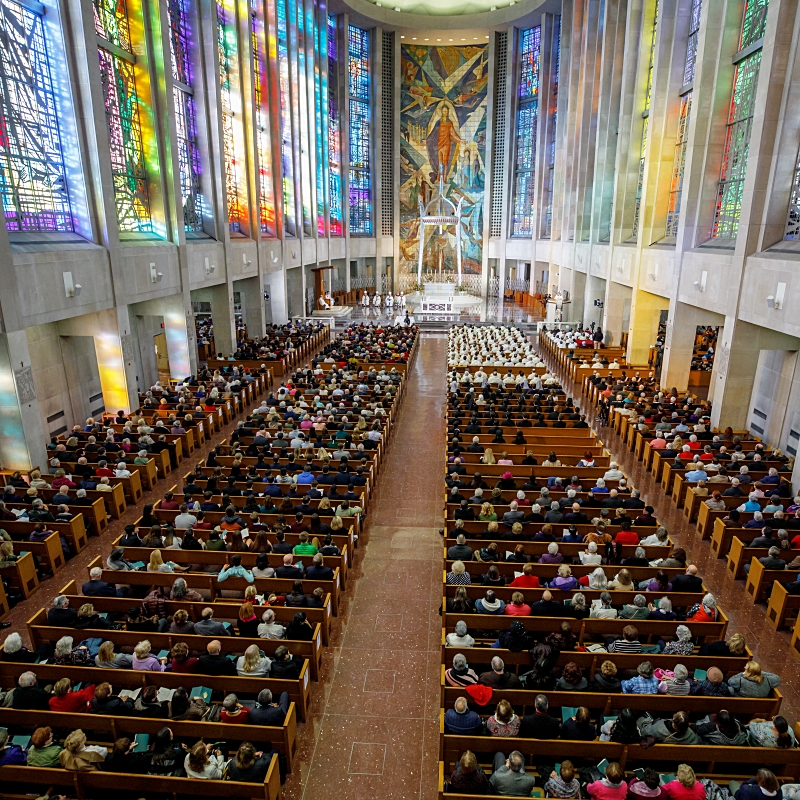
steadily. On February 10, 1961, Archbishop O'Brien consecrated 12
carillon bells, cast in Holland; on October 3, 1962, Auxiliary Bishop
Hackett laid the cornerstone, while on April 3, 1962, the Archbishop
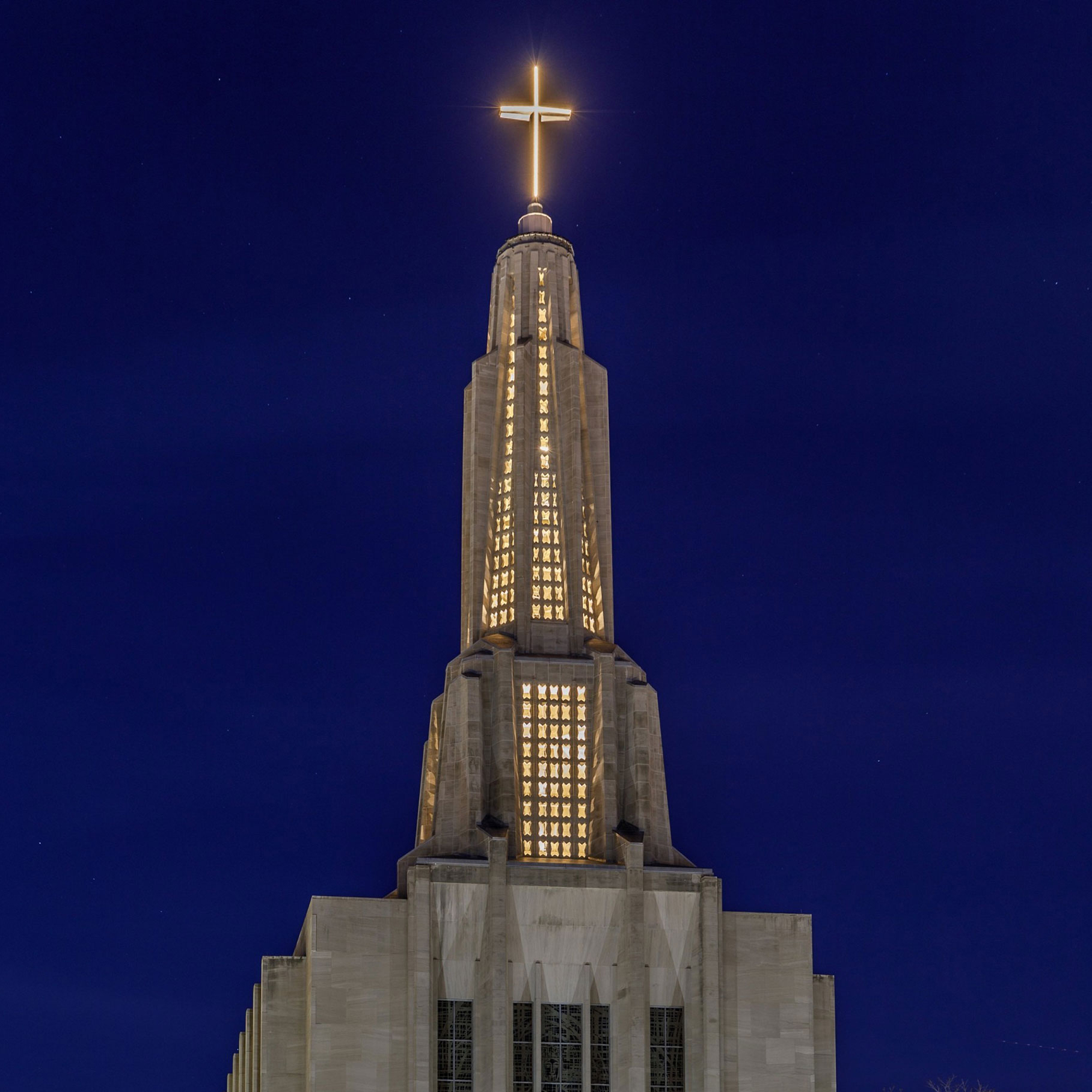
blessed the cross for the tower. Finally on May 15, 1962, the Auxiliary
Bishop consecrated the completed edifice.
|